
Any knowledge not to be shared belongs to a secret category of knowledge, in contrast to knowledge that belongs in public sphere and is solemnly disseminated. In the written works of art, what is constituted as public finds its definition in romance; what is hidden becomes gothic.
The narration of a gothic secret can release itself of the romance only by excluding the inherently nostalgic romantic elements. This act of exclusion exhausts exponentially the rationality by situating the mind and decision-making faculty under potential secret attacks from various directions. What is happening in a gothic novel is a narration of nothing but the dark side of ‘a’ history. Charles Brockden Brown, by authoring exclusionary novels of this kind, starting with Wieland and historicizing with Edgar Huntly or Memoires of a Sleepwalker, discovered an array of these directions. An American style of discovery through the perspective of a frontier. To breathe soul into his narration, Brown employs, I argue, a kind of Gothic Kinesis, by which I intend that he portrays actions in a series of ultrasonic movements happening beyond the rationality of a sane judging mind.
He must have observed carefully how at certain times some moves are fast and irrational but seem rational to naturally slow observer.
I see an analogy in this novel to the non-kinetic technique of Franz Kafka in Metamorphosis in portraying surrealist elements. While Kafka portrays irrationality by saying ‘Yeah that’s it and no more judging’, Brown portrays irrationality by saying ‘Hey what’s that? Start judging’ and judging has the potential to lead to an open-ended madness. The act of judging entails grappling with themes of morality, guilt, innocence and rationality and if judgment turns out to be multifarious then that is exactly what Charles Brockden Brown wants the reader to perceive of his time and that is the connection for us to history in that time.
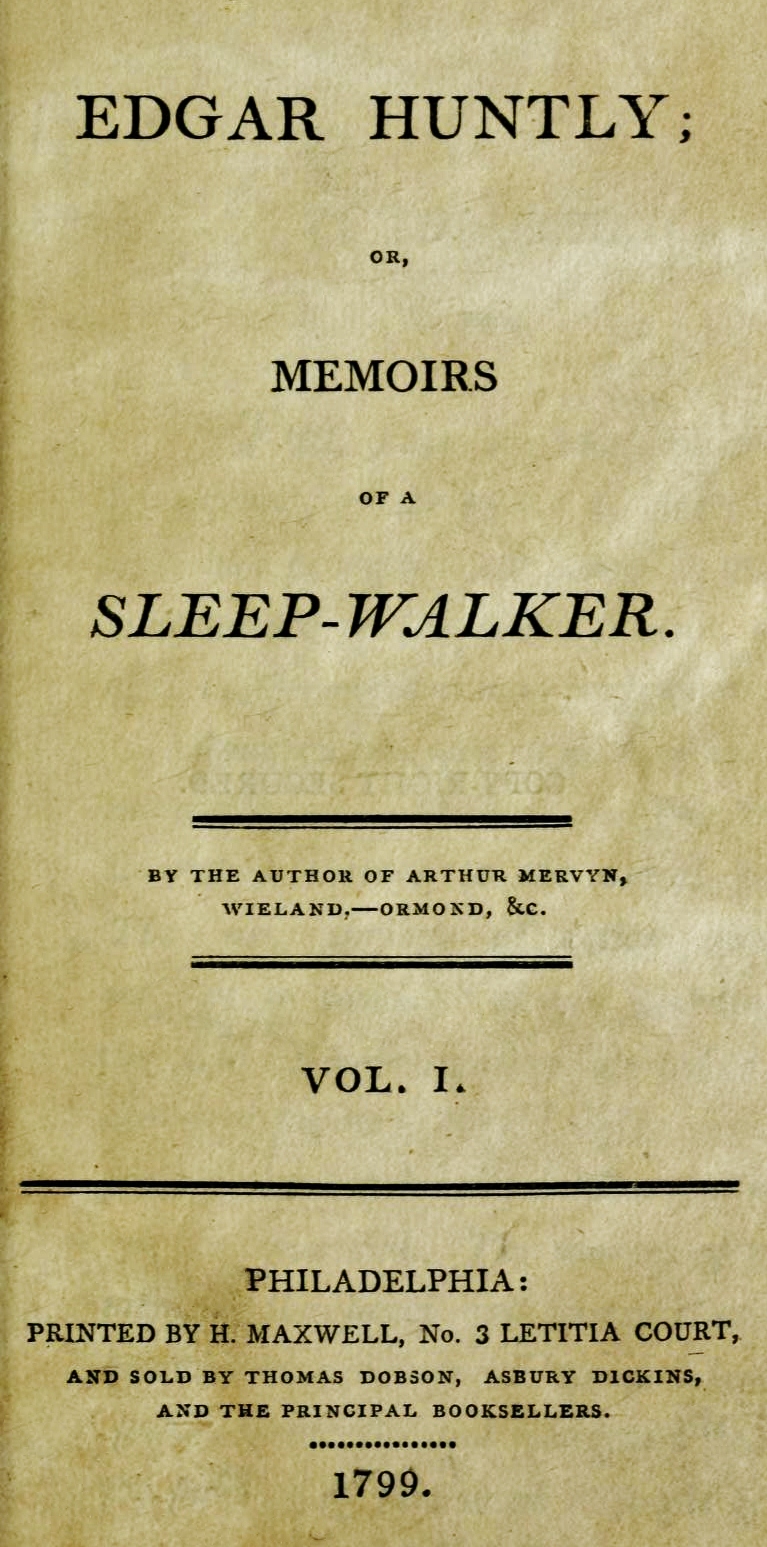
Edgar Huntly or Memoires of a Sleepwalker was published at the end of 18. c. in 1799, 10 years after the American War of Independence in 1789 and tells of a story in 1778. In the timeframe when Brown wrote, there was an invisible public disregard for reading works of fiction because of faith in book’s ‘use’ and a visible local disregard to the ‘other’ in general because of an ‘exceptional’ sense of Enlightenment. The rationale behind such Enlightenment that had the potential to exclude European elements, could equally and paradoxically mean the exclusion of self and sense perception. Everyone outside the birth privileges of American gentry could see himself in a way or another left out on his own in the hand of future. At this time in America, to think it in the light of Enlightenment is to hold onto the Americanized notion of building an opposite to remain American; in this regard, to sound non-European by seeking legitimization through some other means which they found and called “social mobility”. Their idea of social mobility, free from blood right, prevailed but only on the grounds of trade and production.
Thus, a new transition was underway. A social order was conceiving a new entity in its womb by going from feudalism and gentry rights to business and plantations of trade. The Enlightenment had seemingly paid off in offering hope for all to climb up the social ladder, well, much clearer, the lives of ‘the other’ as its steps.
Brown could see endless potential in the America during this period, all of which were made sense of in a way to the benefit of some even in the newly occurring transition. The effects of this “sense-making” could only be traced and realized in the mind of the people excluded from this transition and to tell of these effects Brown told of the somnambulism of Edgar Huntly or Memoires of a Sleepwalker.
The historical nexus to the modern reader cannot be seen anywhere throughout the novel without reliance on the preface of the Brown’s novel. He knows what he is doing. He knows how to differentiate doing it. He even knows what it is that makes an American ‘American’. Insisting on difference between America and Europe, an insistence now embedded in the cultural mind of the American, Brown opens the novel to a foreword ascertaining how “new motives to curiosity should operate, that the field of investigation, opened to us by our own country, should differ essentially from those which exist in Europe” (Brown, 1799). So, we know firsthand that the novel is to introduce a novel meaning. Afterwards, to set the stage on a new ground, he lists themes available to the American and not the European. It is very analogous to a conversation between two Americans and one silent European and a crowd who, like audiences in a theater, can watch the scenario on a stage:” The incidents of Indian hostility, and the perils of the Western wilderness, are far more suitable; and for a native of America to overlook these would admit of no apology” (Brown, 1799). Here springs out a highly demarcating word that fixates the American’s impression of selfhood at this point in history. He does not speak of an Indian society, or an Indian theme or Indian people or even simply Indians but clearly states that (Lenni Lenape) Indians are hostile to ‘native’ Americans and that hostility that lives in the wilderness should be used equally as the way chimeras in the Gothic castles are elements of Gothic fiction for the European. Throughout the novel, my reading converged in the conclusion that when the mind is utterly troubled, it’ll wander on the saddle of somnambulism, – called subconsciousness later by Freud – into the caverns of wilderness where, with all the rational powers that a mind can have, only terror is born in the name of morality.
The way wilderness and ‘the other’ – or savages as called by Edgar – is depicted in the novel, tells how the meaning of morality is shaped to the reader. A madman like Edgar justifies his actions as moral by watching another madman, Clithero.
Going around with an obsessive aim and yet aimlessly. Haunting others around and yet being haunted by a thought. Breaking up with a pregnant girlfriend, Mary, by returning their fortune from Waldegrave to a businessman, Weymouth, based on no proof and calling it morality. In the whole novel we are left wandering in finding a reasonable course of events, only to find that nothing makes sense in the narration. As Edgar tells of the actions in the whole chain of events with his emphasis on reasoning and morality and as if there is a lesson to teach others, a look from outside all the events, conveys the potentially unreasonable and immoral nature of his rationality.